Scientific Research
I wanted to be a paleontologist and zoologist when I was a kid...but life turned out differently (it always does). Now, I'm chiefly a geneticist - one who studies how the sequences and activities of genes guide how biological populations function and evolve.
Currently, I am a PhD student at the Pallares Lab, where my research addresses factors influencing how gene expression variability might evolve using genomics and bioinformatics approaches. Low variability means individuals tend to express more or less the same amount of gene product (e.g., mRNA) around some average value, while high variability means individuals deviate highly from it. While determinants that distinguish low-variability genes from high-variability genes have long been appreciated, factors underpinning shifts in variability of individual genes remain relatively undercharacterised, especially in multicellular organisms. TIn lieu of this, look forward to new work on how a defined stressful diet and genetic variation affect gene expression variability, made possible through Drosophila melanogaster fruit flies.
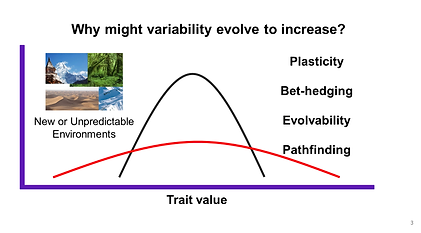
This research belongs to the burgeoning research area of biological phenotypic variability (or biological noise), which ties together various theories and phenomena in evolution, development, quantitative trait genetics, and molecular gene regulation, some of which are highlighted below:
This first work is now available online as a preprint at https://www.biorxiv.org/content/10.64898/2026.02.18.706644v1. It is awaiting to be peer-reviewed but in the meantime, I hope it inspires thought and discussion. I'm working on new things too that I hope to share soon...
More broadly, my work is guided by cell developmental biology, evolutionary genetics, neuroscience and biostatistics. In my past lives, I helped researchers identify genes whose expression may better predict breast cancer patient survival, narrow down parts of a molecular code that 'stabilizes' the number of smell neurons in Drosophila, and characterise genetically-engineered strains of mosquitoes holding promise to reduce the spread of malaria.
For more details on my scientific work, publications and engagements, please check out my CV!